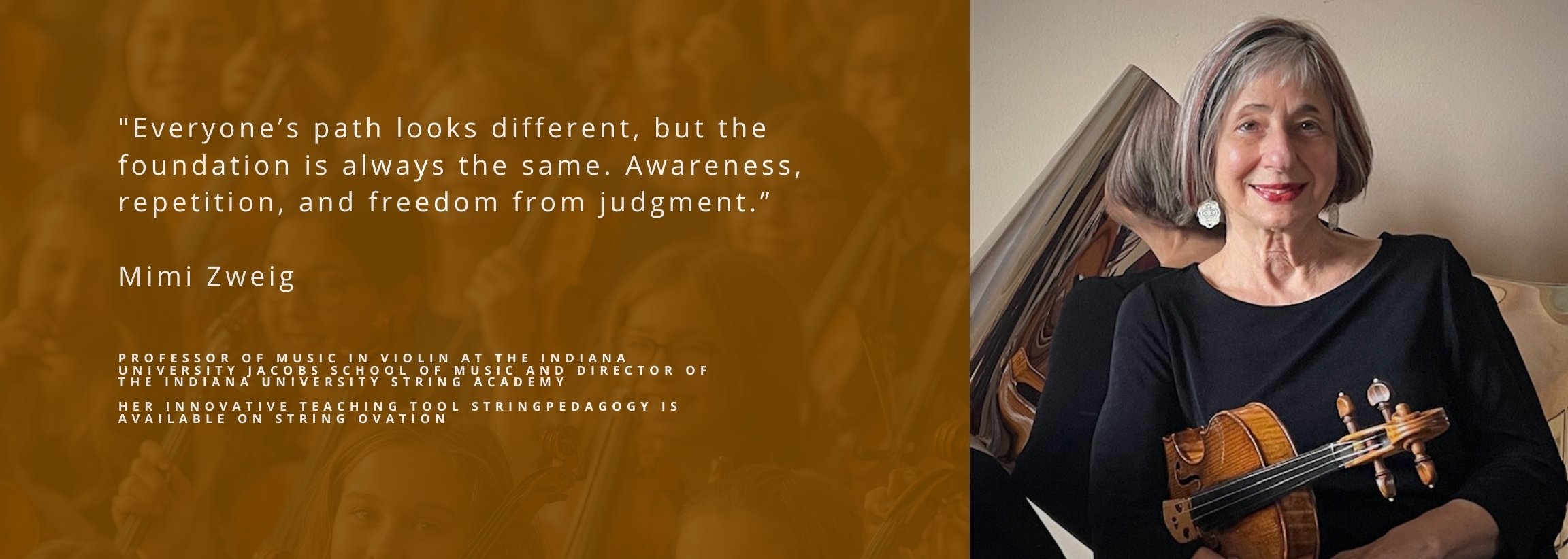
At StringOvation, we believe great teaching shapes not only skilled players, but thoughtful musicians.
Few educators have influenced violin pedagogy as profoundly as Mimi Zweig. Known for her clarity, precision, and deeply human approach to teaching, she has guided generations of students and teachers toward more intentional, effective practice.
In this conversation, she shares her philosophy on practicing, developing musicality, and navigating the realities of a life in music.
Practicing with Clarity, Not Just Time
Q: How do you teach students to practice efficiently rather than simply for long hours?
Practicing, from the very beginning, from the very first lessons, is just a matter of repetition. And if we're able to isolate what we need to repeat, we can solve all the problems we know.
At the simplest level, all difficulties occur between two notes. If we, the student and the teacher, can identify those two notes, then most likely we can figure out how to make the correction between those two notes.
“All difficulties occur between two notes.”
One thing that's really important in this whole discussion is to put ourselves in a nonjudgmental environment. That environment states that we're happy to make mistakes because then we know we can fix them.
If we judge ourselves and make a mistake, the natural inclination is to say: “Oh, I must be a bad violinist…” Those thoughts cause anxiety, and anxiety creates tension. And it is very difficult to play this instrument if we are tight.
So we allow ourselves to make mistakes, and we learn how to fix them.
Becoming Your Own Teacher
Q: How can students find problem spots when practicing on their own?
They can listen, and they can record themselves.
I actually record most of my students’ lessons so they can go home and be their own teachers. Technology has made this incredibly helpful.
For younger students, parents are involved. We give very specific instructions—how many times to repeat something, what to focus on—and even simple tools like checklists and incentives.
If all the boxes are checked, they get a sticker. We are happy to use incentives. They love the stickers.
Structuring Practice at Every Level
Q: How should students balance technique, musicality, and repertoire?
It depends on the level.
More advanced students don’t need hours of technical work every day. They can begin with what they’re working on, supported by scales and etudes like Kreutzer, Rode, or Fiorillo.
Younger students may work through scales, etudes, shifting exercises, and then repertoire.
“There is no one structure—it evolves with the student.”
Building Musicality from the Beginning
Q: How do you approach students who learn at different rates?
From the very beginning, we talk about phrasing—even in Twinkle.
In Suzuki Book 3, we introduce strong and weak beats. In Vivaldi, we work on sequences, articulation, and phrasing.
As the student develops, all of that investment comes together. By age 11–13, they’ve mastered the toolbox of bow strokes, speeds, and pressures so they sound musical.
I don’t give up on anybody. Everyone has it in them—it just takes longer for some.
Earning Student Trust
Q: Are there habits you wish all students would adopt?
Students need to believe what we’re telling them.
If I can demonstrate something in a lesson—like how to create a more beautiful martelé—they hear it immediately. That builds trust.
From there, everything becomes easier.
The Reality of a Music Career
Q: What’s a hard truth for students pursuing violin professionally?
I ask: “Is this what you want more than anything else?”
If yes, I tell them:
- You won’t get rich
- It’s a long journey
- There are no guarantees
But there are many paths—teaching, administration, or combining music with another field.
“It’s a long journey, and there are no guarantees.”
And sometimes, students discover for themselves that the level of commitment required isn’t what they want. That realization is valuable.
Beyond the Instrument
Q: What do you hope students carry with them beyond violin?
I often say I wish all politicians had studied the violin.
They would understand discipline, perspective, and what it takes to create something meaningful.
What lasts in history is culture—art, music, creativity. That is what carries society forward.
A Future Worth Believing In
Q: What would you change about classical music education today?
People say classical music is dying, but I don’t see that.
The level of playing is incredibly high. Concerts are full. Students are engaged.
I am optimistic for the future.
Closing Thoughts
Mimi Zweig’s teaching reminds us that progress is not about practicing more, but practicing with clarity and purpose.
Her approach centers on awareness, trust, and the belief that every student is capable of growth.
At its core, this is not just a philosophy of violin playing—it is a philosophy of learning.
About StringOvation
StringOvation is a community for string educators, offering curated resources, insights from leading pedagogues, and access to thoughtfully selected tools for teaching and performance.
Join the free StringOvation program for exclusive perks, classroom tools, and seasonal savings — made for teachers and performers alike.
Share this article