
Teaching Beyond the Notes: A Conversation with Angela Harman
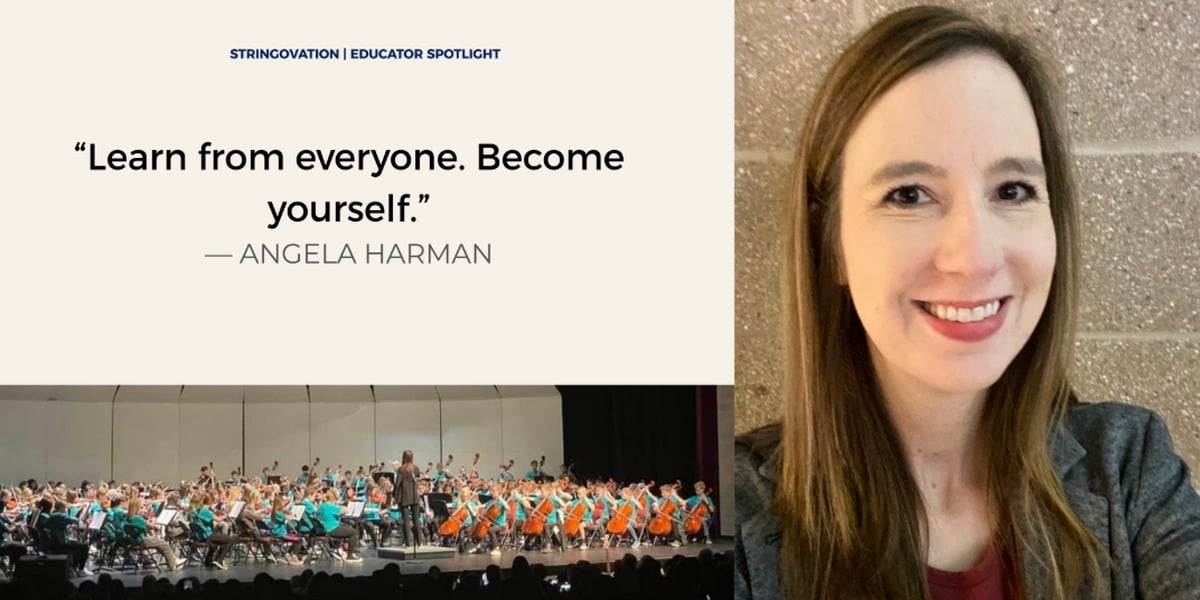
The best orchestra teachers don't simply teach music, they design experiences that help students discover what they're capable of.
Angela Harman has built one of Utah's largest middle school orchestra programs, but her approach to teaching goes far beyond enrollment numbers, rehearsal techniques, or classroom management strategies.
At the heart of her philosophy is a belief that students thrive when they feel connected, challenged, and capable of more than they imagined.
In this conversation, Angela reflects on the experiences that have shaped her teaching, the lessons she's learned from ideas that didn't work, and why the most meaningful work of an orchestra teacher goes far beyond teaching notes and rhythms.
Tell us about your journey as an orchestra teacher.
I'm a product of a school orchestra program. I started playing violin in fifth grade, fell in love with it, began taking private lessons, and eventually became an orchestra teacher myself.
After teaching for a couple of years, I stepped away to raise my family. During that time, I immersed myself in Suzuki education, ran a Suzuki studio for nearly ten years, and fell in love with a philosophy that was so different from how I had learned.
When I returned to the public school classroom in 2012, I realized this was where I was meant to be. Teaching beginning orchestra is truly my greatest passion.
Early in my career, I thought I needed to teach like the great teachers I admired. I remember attending a workshop where an outstanding band director talked about having pin-drop quiet rehearsals. I thought, "That's what I'm missing. If I'm going to be a great teacher, my rehearsals need to look exactly like that."
So I went back to my classroom and tried to adopt his philosophy.
It just wasn't me.
I've learned that we should always keep learning and growing as teachers, but we also have to stay true to ourselves. Great teachers don't all teach the same way.
“You don't have to be like anybody else.”
What do you want students to experience when they walk into orchestra?
I want my classroom to feel like a completely different world.
I feel like school is kind of good at killing curiosity because students get stuck in routines—tests, quizzes, homework, grades. It becomes, "Just tell me what I need to do to get my A, and then I'm done."
When I sit with a student and help them, I take away the whole grading element because I think that frees them up to make mistakes, learn from them, and grow without the fear of a bad grade.
When students come into my classroom, I want them to almost feel like they’re entering a whole new world that isn’t even part of school. I want that anticipation, that energy, that feeling of possibility.
I want to create a place where students feel safe to take risks, overcome challenges, and discover what's really possible for them.
I think that's the magic of what we do.
I want my classroom to be a place they're excited to walk into...
...and proud of themselves when they walk out.
Why do you put so much energy into recruiting?
When I recruit students, I always tell them, "This is your chance to be part of something big."
And it's not big because the program is big.
It's big because I truly believe that joining a music program is life-changing. That's the deeper purpose of recruiting. You're inviting students into an experience that can shape who they become.
“That's why I believe orchestra is for everyone. I think it's a place where students discover what they're capable of.”
How can you tell when students are truly invested?
I feel like I could walk into any classroom—even my own—and see different levels of investment on the surface. But deep down, I truly believe every student is invested because they've chosen to be there.
Even if they're being sassy one day or seem distracted, I still believe they're invested.
As soon as I start thinking, "They don't care," everything changes: my attitude, my classroom, the way I interact with students.
But if I approach students believing they do care, it opens my heart. It changes the way I teach, and I think everything goes better.
I had a cello student who struggled for months with his left-hand position and bow hold. No matter what we tried, nothing seemed to stick, and he was falling behind.
As parent-teacher conferences approached, I thought I was going to have to tell his parents that maybe orchestra wasn't the right fit for him.
Before I could say anything, his parents told me how excited he was about orchestra. He talked about it all the time. He absolutely loved being there.
I had completely misread the situation.
“Because he was struggling, I assumed he wasn’t invested.”
Hearing his parents changed everything. It reminded me that when we really get to know our students, they often care much more than we think they do.
How do you design rehearsals that keep students engaged and learning?
I'm constantly asking myself questions.
Even while I'm teaching, I'm thinking, "Where are students getting stuck?" and "What experience can I design that removes those barriers so they can't help but learn?”
I'm always trying to see the rehearsal through my students' eyes. If I were sitting in this class, how would this feel? How long could I stay engaged before I started getting bored or overwhelmed? When do I need to change activities?
I'm always thinking about how to make the experience engaging while still making sure students are learning and growing.
Every single day, I start class with a short YouTube video. It's always connected to something we're about to learn. People probably think that takes a tremendous amount of planning, but one of my secret talents is that I can connect almost any video to what we're doing in orchestra.
It's really just a hook. Sometimes it's an inspiring performance. Sometimes it's a demonstration of a technique we're about to learn. Some people probably think spending two or three minutes on a video is a waste of rehearsal time, but for me, the payoff is huge. It gives students a shared point of focus, gets them excited about what we're about to do, and helps create the right mindset before we begin rehearsing.
Can you tell us about an idea that didn't work?
Absolutely.
I read The War of Art, which talks about how people naturally resist doing difficult work, and it got me thinking about ways to motivate students.
So I created a whole ninja belt system. Every student had a clip with their name on it, and they moved through different colored ribbon belts as they mastered songs and skills.
It took forever to make.
And it was a huge failure.
Most students didn't care about earning the next belt.
I remember thinking, "Why don't they want to earn the black belt?"
Eventually I realized I couldn't depend on an elaborate motivational system to make students want to learn. If I want students to learn something, it's my job to guide them through it.
That experience reinforced something I think about all the time: the payoff has to be worth the investment. Sometimes the simplest approach is the best one.
New teachers are exposed to so many great ideas. How do you know which ones are right for your classroom?
I think every great idea has to go through a filter.
There are so many amazing teachers out there, and we should absolutely learn from each other. But after hearing a great idea, we have to ask, "How does this fit my personality? What would I need to change to make it work for me?"
I remember teaching high school and getting frustrated because students kept arriving late. A colleague suggested having an assignment due in the first few minutes of class and not allowing students to make it up.
It was great advice.
So I tried it. It completely changed the tone of my classroom. Students with legitimate reasons for being late suddenly had grades that suffered, and my class became more about points than the experience I wanted us to have together.
So I stopped doing it.
Instead, I focused on starting class on time, building relationships, being understanding, and creating the kind of classroom students wanted to be part of. The tardies didn't magically disappear, but my focus changed—and that was the better solution for me.
I've learned so much from other teachers over the years. But every great idea has to go through a filter.
Where can teachers connect with you and find your resources?
I have a website, orchestraclassroom.com, where I share curriculum, worksheets, and other resources.
Most of my materials are available on Teachers Pay Teachers under the store name Orchestra Classroom. I like using that platform because teachers can instantly download resources, and I can share new ideas very quickly. I probably have at least sixty free resources available because I'm constantly creating and trying new things in my own classroom.
I also share ideas on Instagram at @orchestra.teacher.life. I always encourage teachers to take ideas with a grain of salt. Take what works for you, leave what doesn't, and adapt things to fit your own classroom.
I'm never offended if someone takes one of my ideas and changes it. I'm simply sharing what works for me in hopes that it sparks creativity in someone else.
"Learn from everyone. Become yourself."
Angela's perspective is a reminder that great teaching isn't about finding the perfect system or recreating someone else's classroom. It's about continually learning, reflecting, and creating experiences that help students grow.
And perhaps most importantly, it's about trusting that the teacher you are can be just as effective as the teachers you admire.
Join the free StringOvation program for exclusive perks, classroom tools, and seasonal savings — made for teachers and performers alike.
Share this article


