Tracy Silverman on Why Groove Belongs in Today's Orchestra Classroom
Beyond the Notes
Tracy Silverman on Groove, Relevance, and the Future of String Education
What does it take to prepare today's string students for tomorrow's musical world?
Classical training remains the cornerstone of string education, giving students a foundation in technique, artistry, and discipline that has endured for centuries. But as music educators look for new ways to engage students and connect classroom learning with the music students hear beyond the orchestra room, many are exploring how contemporary styles can complement—not compete with—that tradition.
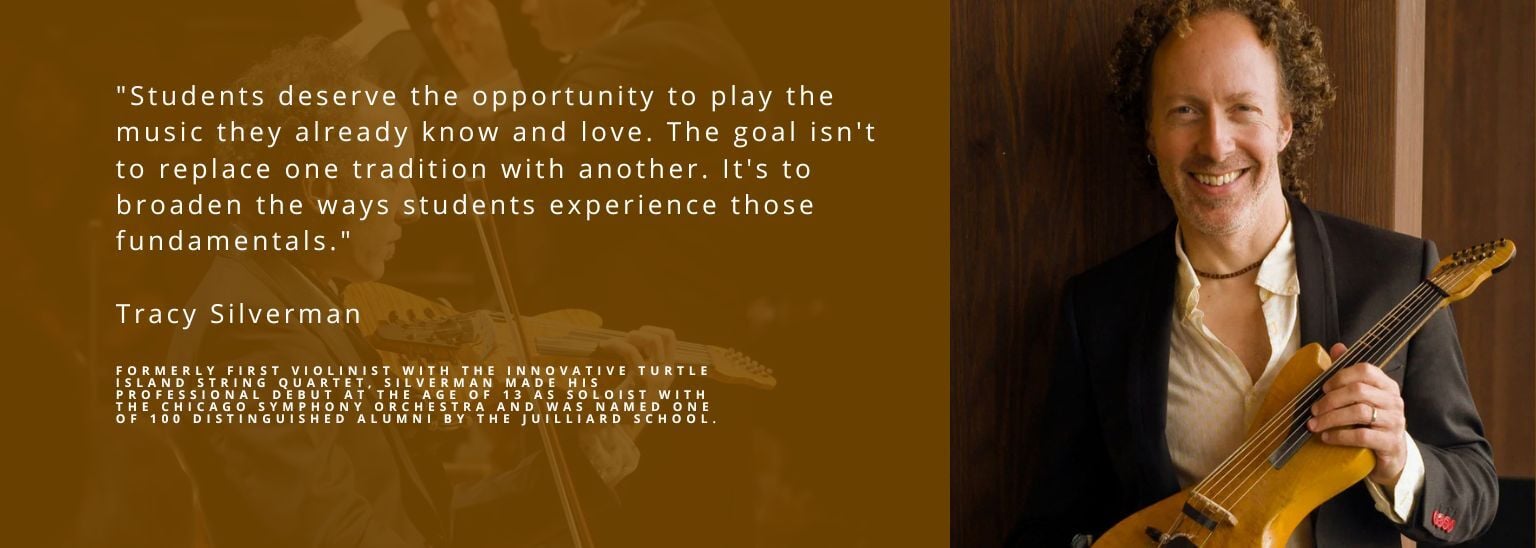
Few people have spent more time thinking about that intersection than Tracy Silverman. A Juilliard-trained violinist, internationally recognized electric violinist, and creator of the Strum Bowing Method, Silverman has dedicated his career to helping string players develop the rhythmic fluency, creativity, and versatility demanded by today's musical landscape.
In this first installment of our two-part conversation, Silverman shares why groove belongs in the orchestra classroom, how contemporary playing can strengthen traditional technique, and why expanding students' musical experiences may be one of the most effective ways to inspire the next generation of string players.
Editor's Note: This interview has been lightly edited for length and clarity.
String Ovation: For educators who may be new to your work, tell us a little about yourself. What is Strum Bowing, and how did it come about?
Tracy Silverman: I'm an electric violinist who originally trained as a classical violinist and graduated from Juilliard. Early in my career, I became fascinated with contemporary music. I played in rock bands, experimented with different styles, and eventually began building electric violins in the 1980s. I was one of the first people performing on a six-string electric violin, and it's been my primary instrument for more than four decades.
My goal wasn't simply to create a new instrument. I wanted to develop a new way of playing the violin that spoke the language of contemporary music.
When you listen to popular music—rock, funk, jazz, hip-hop, country—the guitar often defines the groove. Guitar is really our closest relative in the contemporary music world, so I began asking, How can string players create those same rhythmic textures and energy?
That question eventually became the foundation of the Strum Bowing Method.
Today that work has expanded into the Strum Bowing Groove Academy, an online educational resource that includes instructional videos, method books, etudes, play-along tracks, and progressive lessons covering techniques like ghosting, chopping, strumming, groove development, and rhythmic accompaniment.
Ultimately, it's about giving string players the tools to become more confident, creative, and versatile musicians.
String Ovation: You've said that string playing needs to evolve in order to remain culturally relevant. What does that mean for today's orchestra classroom?
Tracy Silverman: It means giving students opportunities to play the music they already know and love—not replacing classical music, but expanding beyond it.
Classical technique is beautifully suited to the repertoire it was designed to serve. Contemporary styles simply ask for different sounds, different rhythms, and different physical approaches.
Students deserve to learn those skills, too.
When young musicians can play music that their friends recognize and enjoy, orchestra becomes connected to the culture around them instead of feeling isolated from it. That connection is incredibly powerful.
Classical repertoire remains deeply important. But there's also tremendous value in helping students play music that feels relevant to their everyday lives.
That cultural connection helps students feel proud of being in orchestra. It makes the ensemble feel current, exciting, and connected to the broader school community rather than existing as something separate from it.
I've also seen something else happen when teachers introduce this music.
Students bring a completely different level of energy to the stage.
When they're performing a blues tune, a funk groove, or a song they already know and love, you can see it in their faces. They light up.
Parents notice it, too.
I've watched parents pull out their phones, smile through entire performances, and come up afterward saying
"I've never seen my child so excited about playing the violin before."
That excitement matters.
When students feel personally connected to the music they're performing, they're often more engaged, more motivated, and more invested in the entire orchestra experience.
String Ovation: You use the word groove throughout your teaching. For string teachers who may not have much experience with groove-based playing themselves, what do you actually mean by groove?
Tracy Silverman: The simplest answer is this:
If it makes you want to move, it's probably working.
Groove has a physical effect. You don't just hear it—you feel it.
And groove isn't unique to popular music. Classical music has groove, too. Bach's dance movements, bourrées, and minuets were written as dances. They were meant to move people.
Sometimes I think we've unintentionally polished that movement out of the music.
Many classical musicians assume that repeated rhythmic figures should all be played exactly the same because that's how they appear on the page. But that's not how rhythm functions in contemporary music.
A rhythm guitarist would never play every repeated note identically. There are subtle accents, ghost notes, slight variations in emphasis—tiny rhythmic inflections that keep the groove alive.
Those little differences are what make rhythm expressive.
I call them micro-improvisations.
They're small enough that listeners may not consciously notice them, but their bodies certainly do.
That's what separates groove from simply playing rhythms accurately.
String Ovation: If you could redesign string teacher training, where would groove, improvisation, and contemporary playing live within the curriculum? Many orchestra directors also worry that adding those skills means taking time away from concert preparation and traditional fundamentals. What would you say to those teachers?
Tracy Silverman: Front and center.
That doesn't mean abandoning fundamentals.
Students can learn proper posture, healthy hand position, good intonation, tone production, and every other essential aspect of string playing through contemporary music just as effectively as they can through classical repertoire.
I'd also challenge the assumption that groove and traditional fundamentals have to compete with one another.
The real question is what kind of musical education we want students to have. If we want to prepare students for the musical world they'll actually encounter beyond the orchestra room, contemporary styles deserve a place alongside classical training.
Contemporary playing can also strengthen classical playing.
One of the biggest benefits is relaxation.
Everything we do in Strum Bowing encourages natural, efficient movement. Instead of isolating the arms or forcing awkward motions, we're connecting the entire body to the rhythm.
That relaxed approach carries over into every aspect of playing.
When your arms are relaxed, your intonation improves. Bow changes become smoother. Your sound becomes more supple. You have greater control because you're no longer fighting unnecessary tension.
The physical habits students develop through groove playing don't compete with classical technique—they often make many aspects of classical playing easier.
The same skills—tone production, intonation, listening, ensemble playing, and rhythmic precision—can all be developed while working on contemporary repertoire.
String Ovation: Looking ahead ten years, what would you love school orchestra concerts to sound like?
Tracy Silverman: I'd love to see concerts that present classical and contemporary music side by side—with equal commitment and equal respect.
I don't believe contemporary repertoire should replace classical music.
Classical literature is essential for every serious string player.
But contemporary music is essential, too.
Each develops different musical skills, different ways of listening, and different ways of communicating.
The important thing is that teachers don't unintentionally send students the message that popular music is somehow less worthy.
Of course, not every pop song is as artistically profound as Bach. That's a difficult standard for anyone to meet.
But that's also missing the point.
Popular music has a different purpose. It connects students to the music that's already part of their daily lives and gives them another meaningful way to express themselves.
Both traditions deserve a place in the classroom.
Whether you're introducing groove for the first time or looking for new ways to connect with today's students, Silverman's message is clear: contemporary music doesn't replace classical training—it expands what string education can be.
Five Takeaways
- Classical and contemporary music belong together. Students benefit from learning both traditions.
- Groove is something students should feel—not just read. It begins with movement and a physical connection to the music.
- Contemporary playing reinforces, rather than replaces, traditional fundamentals. Students can develop tone, intonation, posture, and musicianship while exploring modern styles.
- Student engagement grows when music feels culturally relevant. Playing familiar music helps students connect more deeply with their instrument and with one another.
- Preparing students for today's musical world requires versatility. Tomorrow's string players need fluency across multiple styles.
Next in the Series
In Part Two: From Philosophy to Practice, Tracy shifts from the why to the how, sharing immediately applicable classroom strategies for teaching groove. From subdivision and movement to ghosting, harmony, and call-and-response, he offers practical ideas educators can begin using with students of all levels.
Connect with Tracy Silverman
Are you a string educator? Tracy offers teachers free access to the Strum Bowing Groove Academy, giving educators the opportunity to learn the method firsthand, explore the course resources, and discover practical ways to bring groove and contemporary playing into their own classrooms. [Get free educator access here.]
Follow Tracy and explore more of his work:
Join the free StringOvation program for exclusive perks, classroom tools, and seasonal savings — made for teachers and performers alike.
Share this article